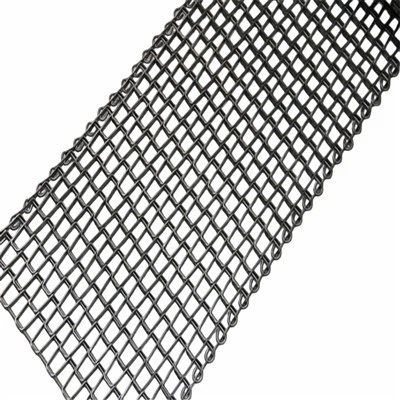

Hey there! As a supplier of stainless steel wire mesh, I often get asked about the tensile strength of our products. So, I thought I'd take a moment to break it down for you.
First off, let's talk about what tensile strength actually means. Tensile strength is the maximum amount of stress a material can withstand while being pulled or stretched before it breaks. In the case of stainless steel wire mesh, it's a crucial property because it determines how well the mesh can hold up under various loads and forces.
The tensile strength of stainless steel wire mesh depends on several factors. One of the most important factors is the type of stainless steel used. Different grades of stainless steel have different compositions, which can affect their strength. For example, 304 stainless steel is a popular choice for wire mesh because it offers a good balance of strength and corrosion resistance. It has a tensile strength of around 515 MPa (megapascals). On the other hand, 316 stainless steel, which is more resistant to corrosion, has a slightly higher tensile strength of about 520 MPa.
Another factor that affects the tensile strength is the wire diameter. Generally, thicker wires have higher tensile strength. This is because a thicker wire has more material to resist the pulling force. For instance, a wire mesh made with a 1 mm diameter wire will have a higher tensile strength than one made with a 0.5 mm diameter wire.
The weaving pattern also plays a role in the tensile strength of the wire mesh. There are different types of weaving patterns, such as plain weave and twill weave. Plain Weave Stainless Steel Wire Mesh is the simplest and most common pattern. It has a relatively high tensile strength in both the warp (lengthwise) and weft (crosswise) directions. Twill Weave Stainless Steel Wire Mesh, on the other hand, has a more complex pattern that gives it better flexibility and a slightly different strength distribution.
Now, let's talk about why tensile strength matters. In many applications, stainless steel wire mesh needs to be able to withstand significant forces. For example, in industrial filtration, the mesh is used to separate solids from liquids or gases. It needs to be strong enough to hold up against the pressure of the flow and the weight of the filtered material. In construction, wire mesh is often used for reinforcement. It needs to have enough tensile strength to support the structure and prevent cracking.
In addition to its strength, stainless steel wire mesh also offers other benefits. It's highly resistant to corrosion, which makes it suitable for use in harsh environments. It's also easy to clean and maintain, which is important in applications where hygiene is a concern.
If you're in the market for stainless steel wire mesh, it's important to consider the tensile strength along with other factors such as the wire diameter, weaving pattern, and the specific requirements of your application. At our company, we offer a wide range of stainless steel wire mesh products with different tensile strengths to meet your needs.
We also offer Stainless Steel Filter Cylinders, which are made from high-quality stainless steel wire mesh. These filter cylinders are designed to provide efficient filtration in various industries.
If you have any questions about the tensile strength of our stainless steel wire mesh or if you're interested in placing an order, feel free to reach out to us. We're here to help you find the right product for your application.


In conclusion, the tensile strength of stainless steel wire mesh is an important property that determines its performance in various applications. By understanding the factors that affect tensile strength and choosing the right product for your needs, you can ensure that your wire mesh will provide reliable and long-lasting service.
References
- ASM Handbook Volume 1: Properties and Selection: Irons, Steels, and High-Performance Alloys
- Stainless Steel: A Guide to Properties, Processing, and Applications by George E. Totten and D. Scott MacKenzie