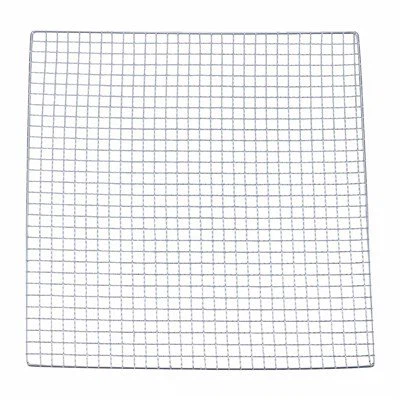
Commercial Stainless Steel Barbecue Grill Mesh for OEM Grill Manufacturers and Industrial Food Processing Equipment
Barbecue grill mesh works as the direct thermal transfer interface between heat sources and food in commercial grills, smokers, and industrial drying systems. Industrial buyers need wire mesh engineered to handle repeated heating up to 600 degrees Celsius without structural warping, scaling, or coating breakdown. Fabrication uses precision resistance welding and expanded metal stamping, ensuring uniform hole spacing for even smoke and heat flow. Standard production follows international food-contact rules, using certified stainless steel to stop heavy-metal leakage under high-heat acidic or salty conditions.
-
![Disposable BBQ Grill Mesh]() Disposable BBQ Grill MeshZero Cleanup: The primary advantage of our disposable grill net is the elimination of scrubbing. After cooking, simply dispose of the mesh, leaving you more time to enjoy your meal.Hygienic & Safe:
-
![Stainless Steel BBQ Grill Mesh]() Stainless Steel BBQ Grill MeshDurable & Reusable: Crafted from high-quality stainless steel, this grill mesh is built to withstand hundreds of grilling sessions, making it an eco-friendly and cost-effective choice.. Superior Heat
-
![Copper Barbecue Grill Mesh]() Copper Barbecue Grill MeshSuperior Heat Conductivity: Copper heats up quickly and distributes heat evenly across the surface, eliminating hot spots and ensuring your food cooks uniformly.. Versatility: Perfect for grilling
-
![Electro Galvanized Grill Mesh]() Electro Galvanized Grill MeshExcellent Heat Retention: The iron core heats up quickly and retains temperature well, ensuring consistent cooking results.. Superior Rust Resistance: The galvanized zinc coating provides a robust
-
![Perforated BBQ Grill Mesh]() Perforated BBQ Grill MeshShapes: Round, Square, Rectangular (with or without handles).. Common Diameters/Sizes: 200mm to 600mm (8 to 24).. Thickness: Typically ranges from 1.0mm to 1.5mm. Thicker sheets retain heat better
-
![Barbecue Grill Mesh with Handle]() Barbecue Grill Mesh with HandleShape: Round, Square, Rectangular, Oval. Dimensions: Width/Length: 15cm - 60cm. Wire Diameter: 1.0mm - 6.0mm. Mesh Hole Size: 10mm x 10mm - 12mm x 12mm. Handle Length: 10cm - 40cm (integrated/folding)
-
![BBQ Grill Mesh with Legs]() BBQ Grill Mesh with LegsShape: Rectangular / Square / Round.. Common Size: round size: Approx. 18-80cm.. Leg Height: Typically ranges from 2.0cm (low-profile for tabletop) to 5.0cm (high-leg for campfire clearance).
-
![Foil Tart Pan]() Foil Tart PanTop Diameter: Ranges from 3.2 inches (82 mm) for mini egg tarts to 4.5 inches (114 mm) for standard individual pies.. Bottom Diameter: Typically smaller than the top, e.g., 2.1 to 2.4 inches (60
-
![Charcoal Barbecue Oven]() Charcoal Barbecue OvenMain Body: Heavy-duty steel / Stainless steel (Grade 430 / 201 / 304). Grill Grate: Chrome-plated or Stainless steel, non-stick and rust-resistant. Handle: Heat-resistant wood or Bakelite for safe


Barbecue Grill Mesh Types
Woven Wire Grill Mesh
Construction: Interwoven warp and weft wires forming square or rectangular openings.
Characteristics: High open area ratio; allows maximum smoke flow and fat drainage; suited for secondary support grates and smokehouses.
Typical Wire Diameters: 1.2 mm to 3.0 mm.
Welded Wire Grilling Racks
Construction: Cross-wire setup with automated resistance welding at every intersection point.
Characteristics: Strong structural stability; stops wire shifting under heavy food loads; keeps a flat plane over direct flame.
Typical Configurations: Double-ring frames with central support bars.
Expanded Metal Grill Grates
Construction: Slit and stretched solid metal sheets forming diamond or hexagonal openings without joints.
Characteristics: Zero joint failure points; high strength-to-weight ratio; efficient heat transfer across the entire surface.
Typical Thickness: 1.0 mm to 2.5 mm.
Crimped Wire Mesh Grates
Construction: Pre-crimped wires locked before weaving to secure structural rigidity under mechanical stress.
Characteristics: High resistance to impact shock during commercial cleaning; stops opening deformation under sustained heat loads.
Materials and Manufacturing Options
AISI 304 Stainless Steel
Standard grade for food contact; contains 18 percent chromium and 8 percent nickel; gives baseline resistance to rust and organic acids.
AISI 316 Stainless Steel
Marine-grade alloy with 2 percent molybdenum; used in coastal areas and high-salt cooking equipment; extra resistance to chloride pitting corrosion.
Carbon Steel (Q235 / AISI 1010)
Low-cost option for high-heat seasoning grates; needs post-production oil coating or porcelain enamel to stop rust during storage.
Aluminized Steel
Low-carbon steel core coated with an aluminum-silicon alloy; handles continuous operating temperatures up to 500 degrees Celsius without scaling.
Surface Finishing Treatments
Electrolytic Polishing
Micro-smoothing process that removes surface burrs; lowers food sticking by 40 percent and speeds up cleaning.
Commercial Chrome Plating
Electroplated nickel-chromium layer giving a bright look and baseline wear resistance for consumer units.
Non-Stick PTFE or Ceramic Coating
Applied via spray systems and cured at 400 degrees Celsius; stops protein sticking during high-heat searing.
Barbecue Grill Mesh Specifications
|
Specification Parameter |
Industrial and Commercial Range |
Testing Standard |
|
Material Composition |
AISI 304, AISI 316, Carbon Steel, Aluminized Steel |
ASTM A240 / EN 10088-2 |
|
Wire Diameter Range |
0.8 mm to 5.0 mm |
ISO 1611 |
|
Aperture / Mesh Size |
2 mm to 25 mm (Custom Pitch Available) |
ISO 9044 |
|
Panel Dimensions |
Max Width: 1500 mm; Length: As Required |
ISO 2768-m |
|
Operating Temperature |
Up to 650 degrees Celsius (Continuous Load) |
ASTM E220 |
|
Food Safety Compliance |
FDA 21 CFR 170-199 / LFGB / EU 1935/2004 |
SGS / TÜV Third-Party Assay |
Commercial Gas and Charcoal Grills: Heavy-duty cooking grates for restaurants and catering equipment.
Smoker Cabinets and Meat Racks: Multi-tier sliding mesh trays for commercial smokehouses and meat processing.
Industrial Dehydration and Drying Tunnels: Continuous mesh belts and trays for drying fruit, vegetables, and herbs.
Outdoor Camping and Portable Cookware: Foldable and modular grilling inserts for outdoor gear brands.


Raw Material Verification: Incoming wire coils and metal sheets undergo spectrometer testing to check nickel and chromium levels.
Wire Leveling and Cutting: Automated straightening machines remove coil curves, feeding raw wire into precision hydraulic cutting units.
Resistance Welding and Forming: Multi-head pneumatic welders make spot welds at wire intersections, keeping pitch tolerances within plus or minus 0.3 mm.
Edge Finishing: Automated deburring and frame wrapping remove sharp wire ends to protect handlers.
Surface Treatment: Parts go through degreasing, ultrasonic cleaning, and electrolytic polishing or coating in controlled lines.
Quality Control and Testing Protocols
Tensile and Peel Testing
Joint shear strength tests check welded spots to verify resistance to mechanical stress under load.
Salt Spray Corrosion Testing
72-hour ASTM B117 neutral salt spray tests confirm stainless steel passivation and rust resistance.
Dimensional Inspection
Optical profile projectors check hole pitch, squareness, and overall size against client CAD files.
Heavy Metal Migration Assay
Chemical extraction tests follow FDA and LFGB rules to ensure zero lead, cadmium, or chromium leakage under acidic food conditions.
Custom Barbecue Grill Mesh Solutions
Industrial equipment design often needs non-standard builds. Engineering support teams work directly with client developers to provide custom specifications, including:
Custom Geometric Profiles
Circular, rectangular, oval, and multi-piece radius grids matching specific firebox shapes.
Integrated Reinforcement
Thickened perimeter support frames, cross-bracing ribs, and detachable lifting handles.
Specialized Aperture Layouts
Gradient mesh densities providing high-heat sear zones alongside lower-heat resting zones in one panel.
OEM Branding
Laser-etched logo plates or custom stainless steel identification tags welded directly to the frame.
How to Choose the Right Barbecue Grill Mesh
Evaluate Heat and Environment
Pick AISI 304 for standard outdoor grilling; upgrade to AISI 316 for coastal, marine, or high-acid marinade environments.
Determine Load and Span Needs
Choose welded wire with reinforced support bars for heavy meat cuts; pick expanded metal for high-frequency scraping environments.
Check Aperture Functionality
Balance hole size to stop food falling through while maximizing open area for heat flow and grease drainage.
Confirm Regulatory Compliance
Ensure the supplier provides batch-specific food-contact test certificates for target export markets (FDA, LFGB, or EU standards).
Export-Grade Packaging: Individual anti-corrosion polybag wrapping separated by corrugated paper sheets to stop surface scratching during transit.
Palletization: Stacked on fumigation-free wooden pallets or heavy plywood crates, secured with steel banding and edge protectors.
Logistics Support: Flexible shipping terms including FOB, CIF, and DDP via ocean container or air freight, supported by complete material test reports and customs papers.

FAQ
We're well-known as one of the leading barbecue grill mesh manufacturers and suppliers in China. With a professional production team, we are able to meet the needs of the majority of our customers. Please rest assured to buy high quality barbecue grill mesh in stock here from our factory.
disposable barbecue grill net, Copper Barbecue Grill Mesh, Disposable BBQ Grill Mesh