

Plain Weave Stainless Steel Wire Mesh
Product Introduction
Plain weave stainless steel wire mesh is a classic and widely used screen product, created by interlacing stainless steel wires in a simple "one over, one under" pattern. This method results in a mesh characterized by square and uniform openings, a strong structure, and a flat surface. It serves as a fundamental component in industrial filtration and has also become a popular choice in architectural decoration.


Material
The primary raw material is stainless steel wire. Depending on the specific requirements of the application environment, the following grades of stainless steel are commonly used for weaving:
Standard Grades: 304, 304L, 316, 316L. Grade 304 is the most widely used, offering excellent corrosion resistance and workability.
Other Grades: 302, 201, 310S, 321, 347, 410, 430, 625,etc., used for specialized environments requiring high temperatures or high corrosion resistance.
Special Materials: Pure Nickel (N:99.5%), etc.
Specifications
The specifications of the mesh are primarily defined by its Mesh Count, Wire Diameter, Aperture, and Width.
Mesh Range: The range is extensive, from 1 mesh for coarse industrial filtration to 600 mesh for high-precision filtration. Common mesh counts include 10, 20, 40, 80, 100, 200, 325, and 400 mesh.
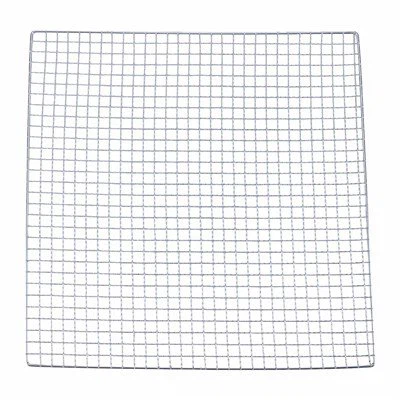
Weaving Style: Plain weave is the most fundamental pattern. Warp and weft wires of the same diameter cross each other, with each warp wire passing alternately over and under each weft wire, creating a uniform and square grid. A variation is Plain Dutch Weave, where warp wires are thicker than weft wires, allowing for higher filtration precision.
Width and Length:
• Standard Widths: 0.914m, 1m, 1.2m, 1.5m. Custom widths can be produced.
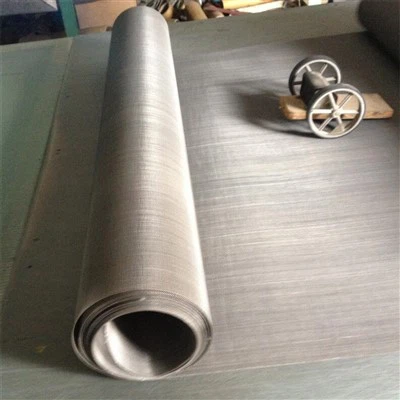
• Roll Length: Typically 30 meters per roll, but custom lengths are available.


Product Features
Robust Structure: The plain weave creates a compact structure with many friction points between wires, resulting in high rigidity and resistance to deformation.
Precise Openings: Openings are square, uniform, and manufactured within tight tolerances, ensuring consistent filtration accuracy.
Corrosion & Heat Resistance: The stainless steel construction offers excellent resistance to oxidation, acids, and alkalis, with a wide temperature range suitability.
Smooth Surface: The wire has a bright finish, making it easy to clean and compliant with food and pharmaceutical hygiene standards.
Electrical Conductivity: As a metal, the mesh is conductive, making it suitable for anti-static applications.
Product Display (Visual Descriptions)
Finished Rolls
The mesh is tightly wound on sturdy paper tubes to prevent creasing, wrapped in moisture-resistant materials, and labeled.
Surface Appearance
Clean, bright, and free of oil stains or scratches. The weave is even, with uniform mesh openings.
Edge Treatment
The edges are trimmed neatly without loose wires to prevent unravelling during handling.


Applications
Thanks to its durability and precision, this mesh is used across many industries:
Petroleum & Chemical Industry
Used as filter screens, catalyst sieves, and for oil and gas filtration.
Food & Pharmaceutical Industry
Used for sieving flour, filtering juices and syrups, and pharmaceutical powder separation.
Mining & Metallurgy
Used for ore screening and metal powder filtration.
Mechanical Protection
Used as safety guards, machine covers, and noise reduction panels.
Architectural Decoration
Used for ceilings, partitions, facades, and handrail infills, offering a modern industrial aesthetic.
Agriculture & Aquaculture
Used for grain sieving and as animal cage mesh.

Packaging & Transportation
Proper packaging is essential to ensure the product arrives in perfect condition.
Packaging
Inner Packaging: The mesh is wound on moisture-resistant paper tubes. Protective materials like kraft paper or plastic film are wrapped around the roll to prevent scratches and moisture.
Outer Packaging: Sturdy plywood pallets, wooden cases, or cartons are used to protect the roll during transit.


Transportation
Suitable for all modes of transport (sea freight, air freight, land courier). Ensure the packages are kept away from water and heavy pressure during loading and unloading.
FAQ (Frequently Asked Questions)
Hot Tags: plain weave stainless steel wire mesh, China plain weave stainless steel wire mesh manufacturers, suppliers, factory, AISI316 stainless steel wire mesh, Dutch Weave Steel Wire Mesh, filter woven wire mesh, plain Weave Steel Wire Mesh, SS302 stainless steel wire mesh, woven wire mesh