

Product Introduction: Metal Spiral Wire Mesh Conveyor Belts
Product Overview
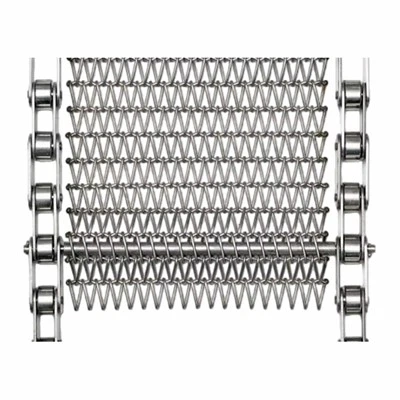
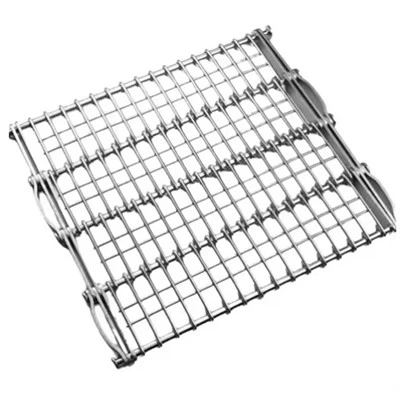
Metal Spiral Wire Mesh Conveyor Belts, also known as chain link conveyor belts or balanced weave belts, are a versatile conveying solution made by interweaving alternating left and right-hand spiral wires, which are then connected by straight or crimped cross rods. This design creates a durable, open-mesh surface that is ideal for applications requiring air, liquid, or heat circulation. The belts are known for their smooth operation, high tensile strength, and minimal tendency to track to one side, making them suitable for both light-duty and heavy-load applications. Their flexible structure allows them to be easily installed and maintained while providing excellent performance in high-temperature or corrosive environments.


Material
Our spiral wire mesh conveyor belts are manufactured from high-grade metals to ensure longevity, strength, and resistance to extreme conditions:
Stainless Steel (SS304, SS316, SS314): The most common choice, offering excellent corrosion resistance and heat resistance. SS316/314 is recommended for food processing and high-temperature environments.
Galvanized Iron/Steel: A cost-effective option for applications where corrosion resistance is less critical.
Carbon Steel: Suitable for general industrial use where high strength is required.
Copper & Brass: Available for specialized decorative or functional applications.
Tin/Zinc Plated Steel: Provides basic protection against rust for light-duty applications.
Finishes: Polished, Heat-Resistant Coating, or Mill Finish.
Specifications
The belts are highly customizable to fit specific industrial requirements and conveyor system designs.
|
Parameter |
Details |
|
Weave Type |
Balanced Weave, Compound Balanced Weave, Double Balanced Weave, Rod-Reinforced |
|
Material |
Stainless Steel (304, 316, 314), Galvanized Steel, Carbon Steel, Copper, Brass |
|
Spiral Wire Diameter |
Typically 0.8 mm to 5.0 mm |
|
Cross Rod Diameter |
Typically 1.2 mm to 5.0 mm, or customized based on load |
|
Mesh Pitch |
Ranges from 2.8 mm to 40 mm (determines product support and airflow) |
|
Cross Rod Pitch |
Ranges from 5 mm to 50.8 mm (e.g., 5.08, 6.35, 7.26, 10.16, 16.94 mm) |
|
Belt Width |
Customizable from 0.2 meters up to 5.5 meters seamless width |
|
Belt Length |
Endless (joined) or open ended, supplied in rolls or cut lengths |
|
Edge Style |
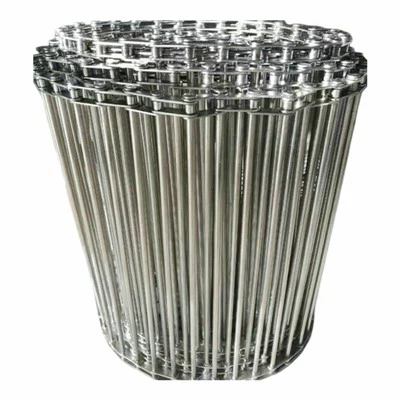
Knuckled (bent), Welded, or with Chain Edges |


Product Display


Typical Applications
Food Processing: Baking ovens (cookies, bread, pizza), freezing tunnels (meat, fish, vegetables), frying lines, and drying units.
Heat Treatment: Annealing, hardening, sintering, brazing, and tempering furnaces for metal parts.
Glass Industry: Annealing lehrs (for bottles and flat glass) and decorating kilns.
Industrial Processing: Cleaning machines, washing lines, and powder coating lines.
Electronics: Handling small components during soldering or drying processes.

Packaging & Transportation
Proper packaging is essential to prevent damage to the belt's links and ensure it arrives ready for installation.

Inner Packaging: The belt is either rolled onto sturdy cores (for smaller widths) or coiled/flattened carefully to prevent kinking. It is wrapped in protective plastic film or craft paper to guard against moisture and dust.
Outer Packaging: For international shipping, the belts are secured in plywood cases, wooden crates, or metal boxes. This protects the mesh from impact and crushing during transit. For smaller belts, reinforced cardboard boxes may be used.
Securing: The belt is fastened with straps or bands to prevent shifting inside the crate. Padding or foam is used to prevent friction damage against the crate walls.
Labeling: Each package is clearly labeled with the product name, specifications (width, length, material), order number, and handling instructions (e.g., "Keep Dry," "Handle with Care," "Do Not Roll" if applicable).
Transportation: Suitable for all modes - Sea Freight (FCL/LCL), Air Freight, and Land/Courier services.


Frequently Asked Questions (FAQ)
Hot Tags: metal spiral wire mesh conveyor belts, China metal spiral wire mesh conveyor belts manufacturers, suppliers, factory, Crimped mesh Belts, Food Processing Mesh Belt 304, Metal Spiral Wire Mesh Conveyor Belts, Metal Spiral Wire Mesh Conveyor Belts Positive Drive Band, Multi functional Spiral Chain Conveyor Belt, Spiral Wire Mesh Belts