

Chain Spiral Wire Mesh Conveyor Belts
Product Introduction
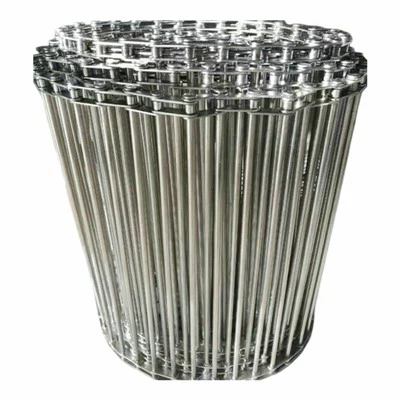
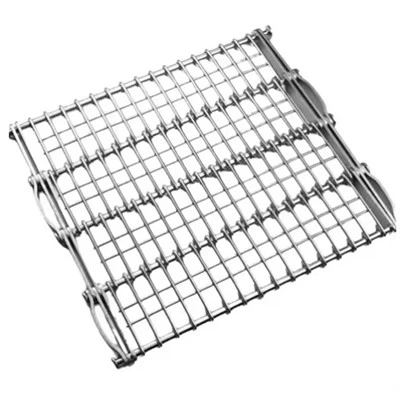
Chain Spiral Wire Mesh Conveyor Belts, also known as Chain Link Belts or Balanced Spiral Belts, are a versatile and durable conveying solution used across a multitude of industries. Their design consists of inter-woven spiral wires, often assembled with connecting rods and supported by precision chains on both sides. This construction provides an excellent strength-to-weight ratio, smooth operation, and the ability to withstand extreme temperatures and heavy loads.


Material
The materials used in manufacturing these belts are chosen for durability, hygiene, and resistance to environmental factors. Common materials include:
Stainless Steel: The most popular choice, available in various grades:
SS304: Offers excellent corrosion resistance and durability, making it ideal for food processing and general industrial use.
SS316 / 316L: Provides superior resistance to chemicals and chlorides, suitable for marine environments and pharmaceutical applications.
SS310 / 310S: Designed for high-temperature applications such as heat treatment and annealing furnaces.
Carbon Steel: Often galvanized or painted, this is a cost-effective option for general material handling where moisture and corrosion are not primary concerns.
Galvanized Iron Steel: Offers moderate corrosion resistance at a lower cost, often used in drying and cooling lines.
Specifications
Chain spiral belts are highly customizable. Key specifications include:
Wire Diameter
Ranges from 0.8 mm to 8.0 mm depending on the load requirements. Common diameters are 1.2mm, 1.5mm, 2.0mm, and 3.0mm.
Spiral Pitch
The distance between spirals can vary from 2.4 mm to 100 mm, influencing the belts open area and product support.
Chain Pitch
Standard chain pitches ensure compatibility with drive sprockets: 25.4 mm (1 inch), 31.75 mm, 38.1 mm, 50.8 mm, 63.5 mm, and 76.2 mm.
Cross Rod Diameter
Typically ranges from 4 mm to 12 mm, providing the belts structural integrity.
Belt Width
Can be manufactured from as narrow as 100 mm (4 inches) up to 6,000 mm (6 meters) wide.
Temperature Range
Engineered to perform in extreme conditions, from -40°C in freezers to over 1300°C in high-temperature furnaces.


Features of Chain Spiral Wire Mesh Conveyor Belts
1. High Temperature Resistance: Withstands extreme temperatures from -40°C to 1300°C, ideal for furnaces, freezers, and heat treatment processes.
2. High Load Capacity: Reinforced with precision side chains and heavy-duty rods, providing superior strength for transporting heavy products without stretching or deformation.
3. Excellent Airflow & Drainage: Open mesh design (up to 85% open area) allows maximum air circulation and instant liquid drainage, ensuring uniform heating, cooling, or drying.
4. Smooth & Flat Surface: Balanced weave construction creates a level plane, offering stable support for small, delicate, or irregularly shaped products.
5. Customizable Design: Fully adjustable in wire diameter, pitch, width, and edge type (knuckled or welded) to meet specific application requirements.
6. Easy to Clean & Hygienic: Non-porous stainless steel surfaces resist bacteria and corrosion. Open structure allows for thorough cleaning via washdown systems.
7. Positive Tracking: Chain-driven engagement ensures straight, stable running at high speeds, reducing wear and preventing misalignment.
8. Long Service Life: Manufactured from durable materials like SS304 and SS316, offering excellent resistance to fatigue, abrasion, and corrosion for extended operational life.

Product Display
Chain spiral belts feature different construction types to suit specific applications:
Standard Chain Link Belt
Features spirals running in one direction, interwoven for simple, lightweight conveying tasks.
Balanced Weave Belt
Composed of alternating left and right-hand spirals connected by straight or crimped rods. This design ensures a flat surface and straight tracking, making it ideal for high-speed applications.
Double Spiral Belt (Heavy Duty)
Utilizes two layers of spiral wire for significantly increased load capacity and durability in abrasive environments.
Edge Configurations
Belts can be finished with knuckled edges for simple connections or welded edges with a complete chain drive system for heavy-load applications.
|
Belt Type |
Open Area |
Max Temp (°C) |
Load Capacity |
Best For |
|
Balanced Weave |
65-80% |
1,100 |
Medium-High |
Food, drying lines |
|
Balanced Spiral Woven |
75-85% |
1,150 |
Medium |
Pharma, electronics |
|
Double Spiral |
50-70% |
1,200 |
Very High |
Metalworking, glass |
|
Chain Link |
40-60% |
800 |
High |
Mining, wastewater |


Applications
The versatility of these belts makes them indispensable in many sectors :
Food Processing:
• Baking: As oven belts and cooling lines for bread, pastries, and biscuits .
• Freezing: Used in spiral freezers and IQF tunnels for meat, fish, vegetables, and seafood .
• Frying & Cooking: For conveying products through oil baths or steam cookers.
Industrial Processes:
• Heat Treatment: Annealing, hardening, sintering, and brazing of metal parts in furnace applications .
• Glass Industry: Annealing lehrs (losing bottle annealing) and decorating kilns .
• Powder Metallurgy: Sintering of metal powders.
Other Applications:
• Washing, Drying & Cooling: For cleaning vegetables, drying components, or cooling manufactured goods .
• Pharmaceuticals: Tablet drying and sterile transport .


Packaging
Proper packaging is crucial to prevent damage during transit. Typical packaging methods include:
Wooden Cases / Plywood Boxes: The most common method for larger or heavier belts. The belt is carefully coiled or folded and secured inside a strong wooden crate to prevent shifting
Steel or Polywood Boxes: Used for very heavy or wide belts requiring maximum protection.
Rolls with Waterproof Paper: For smaller, narrower, or lighter belts, they may be wound onto cores and wrapped in waterproof paper and plastic film.
Pallets: Flat or stacked items can be strapped to wooden pallets and wrapped in protective sheeting.

Transportation
We coordinate reliable shipping to ensure timely and safe delivery:
By Sea: Suitable for large orders. Belts are packed in export-standard wooden cases or pallets and shipped in FCL or LCL containers.
By Air: For urgent orders or smaller samples, shipped via services like DHL, UPS, FedEx, or TNT.
By Land (Express/Courier): For small parcels and samples.

Frequently Asked Questions (FAQ)
Hot Tags: chain spiral wire mesh conveyor belts, China chain spiral wire mesh conveyor belts manufacturers, suppliers, factory, chain mesh conveyor belt, Chain Spiral Mesh Conveyor Belts, Conveyor Mesh Belt, Conveyor Metal Plate Chain Belt, Crimped mesh Belts, Food Processing Mesh Belt 304